TEN DAYS

IMG_2113

There is something about the month of March in our family – the children nearly always fall by the wayside with this bug or that, they can happily navigate their way around all the winter sickness and then March arrives and wham, they drop like flies. I truly thought we had got away with it this year, but first Millie caught a medium dose of bubonic plague at school, and then Roddy found himself unable to walk after an ankle grew to the size of a football.

He claimed to be in some pain so our fabulous neighbour very kindly took him to the local Urgences (ER) in Rochefort as it was a Sunday afternoon.  Several hours later, and armed with a sack-load of antibiotics he returned with an infected foot after spending several hours in one of those silly back-to-front tunics on a wobbly gurney in the corridor while they did blood tests. Back in November when we were still renovating the house, a water tank fell on his foot and his toenail went quite black.  To his credit he just carried on as though nothing had happened and we thought little more of it until he dropped a log on it last week – and although the air went temporarily blue as a vast amount of expletives could be heard, the moment passed without further incident.  However, it appears that the wayward piece of oak caused a septic shock that triggered the infection.  So, ten days later, he is still on crutches and unable to drive or do anything at all.  Garden projects lie half-finished.

Just as I thought that not a lot else could go wrong, Izzi called me from university in the UK; “Mama, I’ve got an awful sore throat and cough, and I’m flying to Milan tomorrow and the doctor is closed!  Help!”.  My advice was simple – drink lots of lemon juice and honey, eat raw garlic and suck on raw ginger.  There was little else I could do from a few hundred miles away in France and I crossed my fingers it would do the trick.

So March finally passed and I welcomed April, quite literally rushed off my feet.  So many extra things to do with Roddy unable to move or drive.  The plum blossom is already over and in it’s place delicate green leaves and the beginnings of fruit.  The cherry now takes pride of place in the garden, it’s magnificent blossom overshadows everything else.

IMG_2122

However, April brought the ants. I came into the kitchen one morning last week to find a trail of dark little specks, speeding across the floor like a tide of black dust, creeping imperceptibly under the dishwasher.  But there was no time to worry about that until I had delivered the children on-time to their respective schools!  With a much needed cup of coffee on my return, chickens let out and fed, kittens fed and husband fed, further investigation revealed a music-festival gathering under the dishwasher, writhing and dancing to some invisible beat.  After pulling the machine half-out, I realized that most of the ants in the Charente-Maritime were actually jamming away under there.  I hurried off to our local garden/agricultural centre, Gamm Vert, the place where you can buy everything – plants, clothing, chicken-feed, ham, cognac, lawn mowers, paint and even an oven, and searched for some ant repellent.  But what did I find on the shelves?  Not much choice of ant poison, but a huge new seasonal selection of snake-repellents!  Lots of the stuff.  I thought I had left Florida and snakes behind, I HATE snakes, and now, if I believed what I read on the shelves, my perfect garden was about to be invaded by all of Europe’s finest venemous varieties. Through my tears I could see shelf after shelf of products of various designs for repelling the mighty asp, the dreaded viper, and the lesser spotted cow-gobbler, or something.  Quietly sobbing I remembered the ant-bait just in time, and drove home thinking dark thoughts about reptilian defenses in the garden.

IMG_2588

Of course when I spoke to our neighbour that afternoon he told me that there were indeed snakes, but  –  not too many would be seen, if indeed any at all.  They were small, and the cats would keep them away as well.  “Just don’t put your hand in any cracks in old walls” he said!

So ants dealt with, snake fears almost allayed, it was time to learn how to use the chainsaw.  Our barn is stacked full of wood but most of it is cut to metre long lengths and I had to halve them to fit our fireplace.  Roddy is normally in charge of this programme, but he was still in his chair and we needed some wood.   I am quite amused that despite being a farmer’s daughter and growing up on a farm I had never used a chainsaw, but after Roddy dutifully hobbled out and showed me how to mix fuel and start the noisy beast, I now know how to cut firewood. He did not have the courage to watch me cut my leg off and hobbled away once he thought I had things under control.

IMG_2082

Easter arrived and along with it came stunning weather; clear blue skies and some much welcomed sunshine.  I set off for Bordeaux airport with Millie to pick up Izzi who was flying in from Milan, thankfully feeling much better.  So excited at the thought of having all five children together again. She had been staying with a university friend whose family lives in Milan as she has two weeks Spring Break.  It was a stunning drive down to Bordeaux as it was Easter Day and the roads were quite empty.  Millie told me all about her forthcoming school-trip the following year to China.  She will be starting Lycée this September, the equivalent of the last three years of High School in the USA, and she has decided on Chinese as her third foreign language choice, alongside Spanish and English.  Of course for her English is the easy foreign language she doesn’t have to even think about (an easy pass as we call it).   Jack, who is 13 in a couple of weeks time, will be going to the Alps with the school next winter for a week learning how to dog-sleigh.  A skill I doubt he will need in life but immense fun!  The two youngest girls are off on a big school-trip on Thursday and have had not one but two parties this Easter weekend.  I have decided I want to go back to being a student; I don’t remember it being half as much fun when I was at school!

IMG_2098

I rarely go to Bordeaux as the airport is an hour and forty minutes south of us and normally everyone flies into La Rochelle.  However, on such a beautiful day it was fun to see new scenery, and with so many vineyards Millie and I had great fun differentiating the organic ones from those using endless pesticides – the latter have grass around the roots which is an incongruous shade of orange.  As I love driving, the time flew past and Millie even managed to take a photo of the River Dordogne as we crossed it at 70kph!

IMG_2102

Easter Monday, I managed to spend a couple of hours in the garden in the afternoon in some easterly sunshine, attacking the weeds that seemed to have sprung up overnight with the warmer weather; the chickens helped as always when Fritz would leave them alone (note to self : spring is definitely in the air), or perhaps they hindered; either way I enjoy their company!

IMG_2161 IMG_3344

I hate it when the children go back to school even after just a long weekend at home; it is always so much fun but suddenly today the house was silent again.  To cheer myself up I stopped on the way back from dropping them off to take some quick photos of the beautiful weeping willow outside Pont l’Abbe, it really is quite fantastic in the early morning sunshine.

IMG_1765

The daffodils along the river beside the willow will soon be past their best; it seems like only yesterday we were so excited to see the first signs of spring and now already we are moving on to the next stage.

IMG_1773

Everywhere the blackthorn is in flower, delicate little white petals which bely the sharp prickly thorns they hide.  I have never seen so much blackthorn; every hedgerow is a sea of white, mile upon mile of surf surging up out of the ditches, its spume blowing across the roads with every gust of the breeze.  There are plenty of old folklore tales about blackthorn; in autumn it bears the sloe fruit, of course, and this year we will be ready with empty bottles and some gin or vodka. If there is an abundance of fruit, which with so many flowers this spring might suggest, it is said it will be a harsh winter – what my Father used to call “a blackthorn winter”.  But still I can’t start thinking about next winter yet, we have only just said goodbye to this one.   Still I learnt to use a chainsaw! I wonder if it will be effective on the snakes !!!

IMG_3043

WHERE THE ROAD TAKES US

IMG_1500

When I was little there was nothing I loved more than exploring around the family farm of my childhood; on my pony, far off the beaten track, it didn’t really matter where I went.  But an unknown lane or a tiny path I had not previously seen meant one thing and one thing only to my inquisitive mind; where would I end up? And when my grandparents came to stay, they would always take my sister and I out for a drive in my grandfather’s pride and joy, his beautiful vintage Rover. Back in those days in England, it was the era of the Sunday afternoon drive, a bone of contention for anyone local and in a hurry for Sunday afternoon drivers slowly cruised along, always looking this way and that with little regard for other traffic. We would join this group playing our favourite game, ‘Left or Right’; at each junction we came to we took it in turns to call which way to go and my grandfather would duly oblige. Frequently we had no idea where we would end up but that was what made it so special, not knowing what we would come across around the next corner.

IMG_1566

Earlier this week, my husband and I did just the same one morning. Having deliberately cleared our desks the night before, we quickly grabbed a cup of coffee and our cameras and jumped in the car on a little exploratory trip after dropping the children off at school. We truly didn’t know where we were going as we headed off into the country, beetling down tiny narrow lanes we had never driven before. All we knew was that the sky was the most perfect blue, the sun was shining and it was a beautiful early spring day; this post is about some of the places we discovered all within half an hour of our house!

IMG_1425

IMG_3031

The roads got smaller and we found tiny hamlets we never knew existed; we came upon villages that we had previously seen signposted but we had never visited.

IMG_3025

IMG_3067

IMG_3062

IMG_1558

On our travels, we came across the most fascinating sign below, proudly announcing the entrance to a village without pesticides. We had never seen such a sign and it more than peaked our interest. As we’re really not fond of the use of pesticides and chemicals ourselves we wanted to know more. Now, what many of you may not know is that every town and village in France has a Mayor (or Mayoress), even if sometimes the Mayor is in charge of two small villages close together. And in each village, the local Mairie will be open for a few hours a day; even if the Mayor himself is not there, the Mayor’s assistant will be, and they are always a fountain of all knowledge. So, having seen this sign, we found the village’s Mairie and went inside to find out exactly what this meant.

IMG_3086

It turned out that since 2007 every community in the Poitou-Charentes region has had an invitation to become part of a movement called ‘Terre Saine’ – a movement dedicated to the voluntary removal of as many pesticides in the countryside as possible. We cannot wait to return in summer for we know the hedgerows will be full of tiny wild flowers, the trees will be covered in leaves, and the blackberries growing wild will be free of chemicals.  Armed with this new found knowledge we continued our little adventure,

IMG_1442

we spied a ruin in the distance which led us even deeper into the unknown as we tried to find it.

IMG_1483

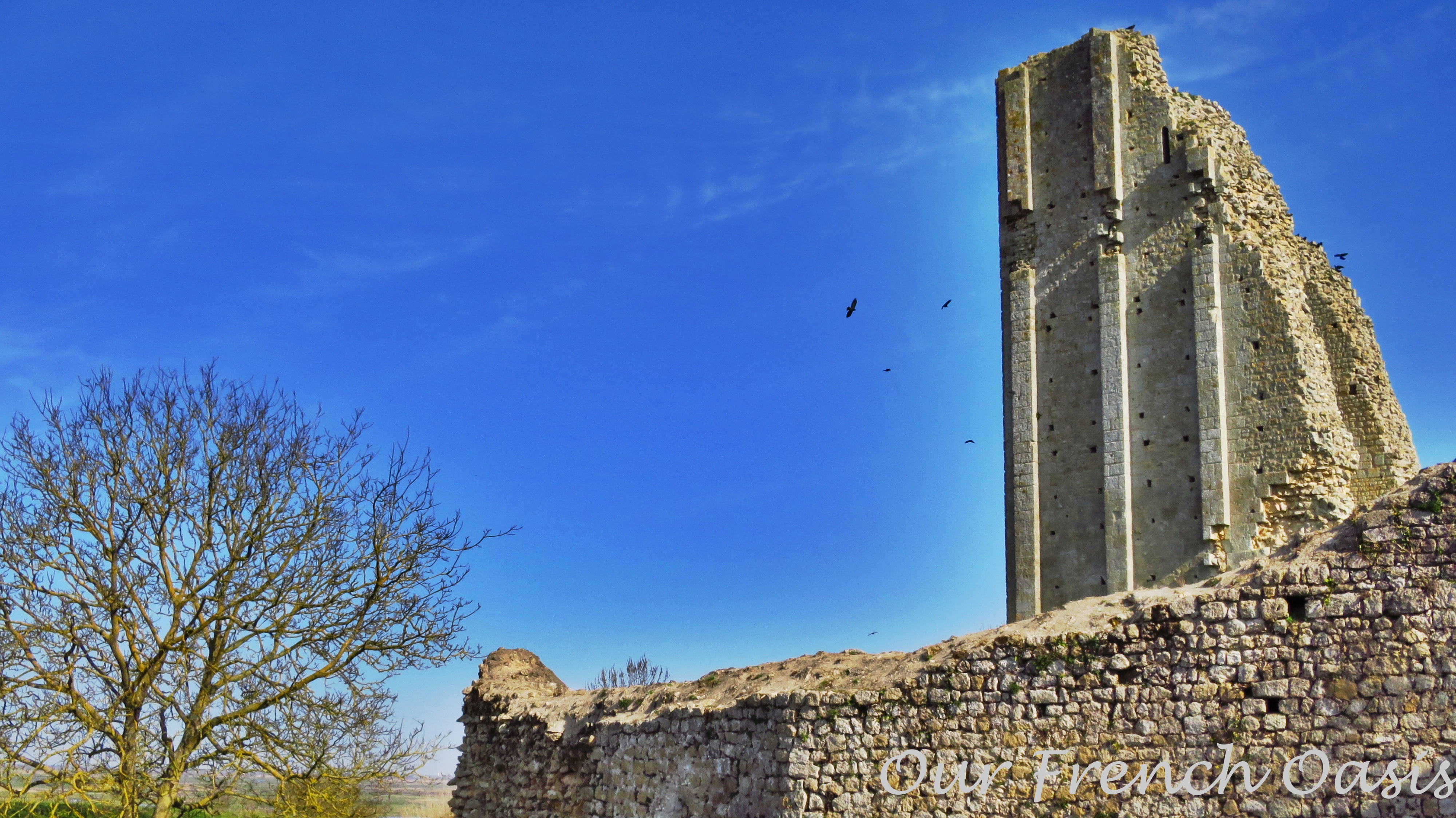
When we finally tracked down the crumbling edifice we found a small information board that let us know that this was ‘La Tour de Broue’. The tower pictured is all that is left of an ancient 11th century fort, situated 27 meters high on a hill that once had the Golfe de Brouage lapping saltwater at its feet each high tide. Designed to give protection and strength to the workers in the fledgling salt industry of that time, it was abandoned in the 18th century as the sea retreated, forming the final part of the vast complex of marais – the marshlands that are a part of the Charente-Maritime’s rich history.  Today only a scattering of ravens haunt it’s lonely ruins, a grim reminder perhaps of when death and desolation was part and parcel for the inhabitants of this rough but stunning countryside.

HDR_3079

I hope you have enjoyed exploring with me and have a fabulous week.

OUR FRENCH VILLAGE BAKERY

IMG_2515

It’s not really something you’d expect to happen in deepest rural France – but then there aren’t too many people with the same interests as my husband, so when a casual exchange about life stories with the baker leads to a demonstration of fish photographs and then an invitation to see the oven, we can’t turn it down.  You see – anything can happen when one fisherman meets another!  And this sparked the beginnings of an idea – over the next few months I want to share with you stories about the local artisans we meet in France and what their jobs really involve – so we start with the life of our village baker.

Truthfully, we’d been wondering about the baker, David Gaillardon, for months. We had lots of questions that needed definitive answers.  How did he survive ? What time did he have to get up to produce the wonderful bread and other goodies we saw each day in the window of our tiny local boulangerie? Has the wonderful tradition of french baking succumbed to the deep-freeze?

IMG_2512


We’ll start at the beginning. There is a bakery in our village.   Most reasonable sized villages have one.  Towns have one on each street.  Bread is a staple of french living and has been for centuries, a staple with its roots entrenched in the mists of time when if there was nothing else to eat, then there was always bread and not just cake, as Marie Antoinette tried to explain before she lost her head in 1793.  Bread and patisserie is a constant of French life and covers a broad subject involving a full spectrum of edible delicacies ranging from the humble croissant (an art in itself) to the magnificent chocolate log of Christmas (the amazing Bûche de Noël).  In between are sundry tartes, gateaux and petits fours, and there is also the use of the oven for cooking the village’s sunday roasts in some far-flung locations. La boulangerie is a magnificent mix of flavors, smells and typical French ingenuity.  And truthfully, no matter how good the food at a table, the French will always have bread at it too.

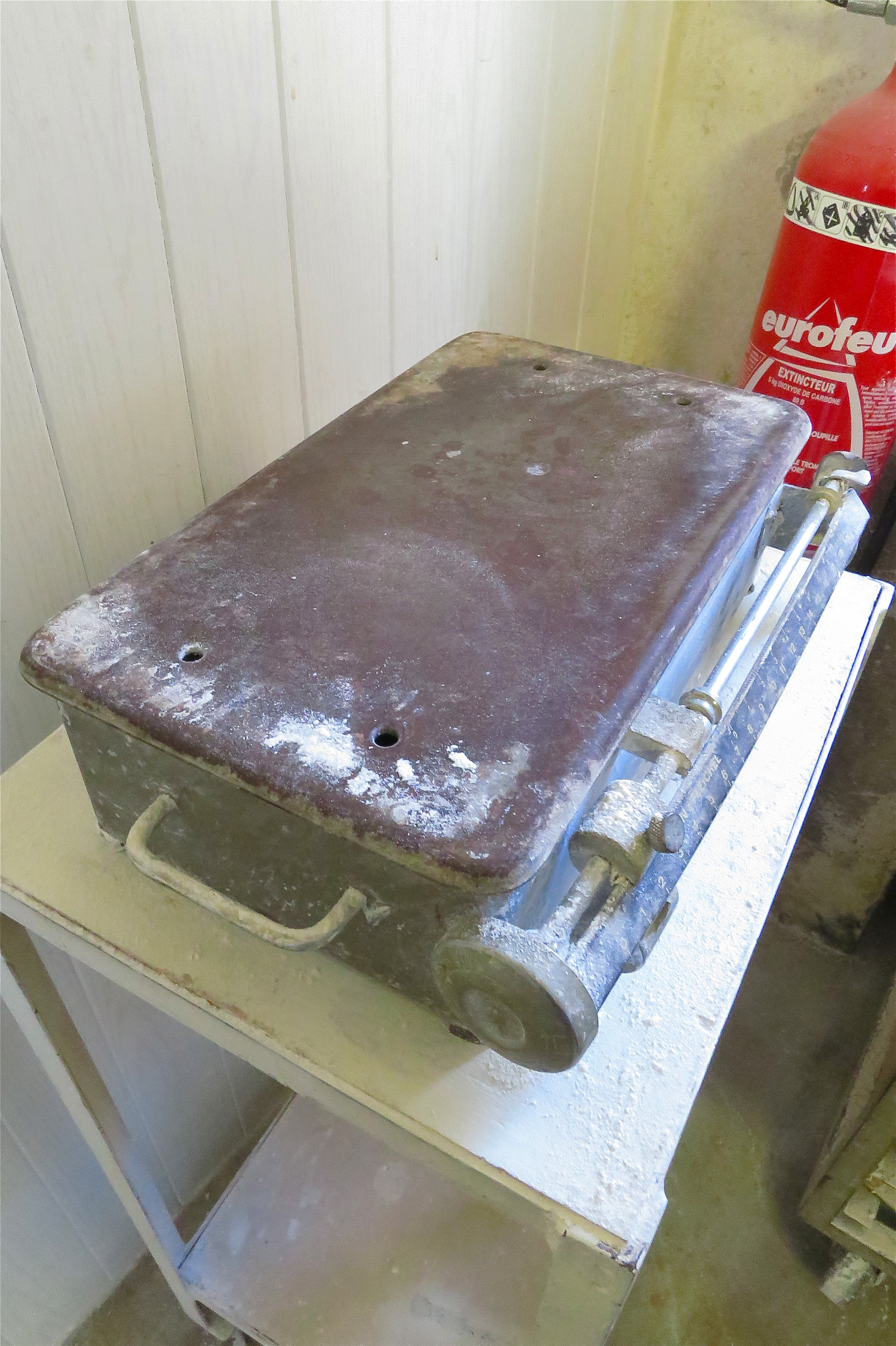
So, the morning of our visit arrives, and we find ourselves outside the small door of the shop just as the sun is rising, and entering the shop David swings aside a section of the counter and leads us to the dim and dusty warren behind.  There is flour everywhere.  There is a small kitchen behind the shop, then a prep room with a long counter and a vast array of knives and chopping boards, and then the oven in its own large space, jostling for room with a huge mixing bowl and two 6’ high proving and chilling cupboards.  Along one side of the room is a big long machine that seems to be left over from a carpet factory – it turns out it rolls the baguettes into shape. There is flour in here too – lots of it – everywhere.  It is the mark of a man who works at high speed for small concentrated lengths of time – for even as we ask questions and take photographs, David is a blur of movement, moving between the oven, the proving cupboards, the shop (each time the door-bell tinkles way out the front), the rolling machine and the bread baskets. While he works Mr H and David talk about fishing and electricity consumption, and I throw in questions more suitable to the surroundings. In a very short space of time we have plenty of answers and many more questions.

IMG_2377 IMG_2388

There are some simple facts we learn quickly. David has been a baker since he was sixteen and he hails from a coastal town a few miles to the south called La Palmyre. In his small, dusty bakery, he single-handedly produces between 300 and 400 loaves of bread each day, AND the patisserie we see out in the shop. I am in awe. I know how much effort a single loaf of bread makes, even with a bread machine, but to make that many ??

IMG_2376

It turns out that of course there is a regime. A method to the madness, and behind it all, a story.  David’s day really starts at about midday.  This is when he combines the four ingredients, salt, flour, yeast and water, needed for his bread – his dough.  In fact, there are two doughs – one for the white bread typified by the traditional baguette, and the dough needed for the pain de tradition, which is not quite the same thing.  David explains that the older generation of customers prefer the bread of their youth, the white crusty baguette, while many of his younger customers have come to like the breads he makes with a flour in which the miller leaves husk and grain in – a minute quantity – but enough to give a difference to the dough and the resulting loaves. This is the pain de tradition. There are also some cereal loaves, and the very different gross pain, a huge mountain of a white loaf with a half-inch thick burn crust that is cut into pieces and bought by weight.  All told, there are normally nine different breads on the shelves each day.

IMG_3630

In simple terms the dough is then divided into the required quantities and then has its first proving.  During the afternoon, at various times, this dough is then shaped in the rolling machine and then proved again until needed.  The two huge proving cupboards both warm and chill for storage.  At odd times during the latter part of the day, David also attends to the requirements of the patisserie section of his shop, making pastry, rolling croissants and pain au chocolate, making flans and tartes, cutting fruits, shredding chocolate and mixing whatever else he decides to bake that day – biscuits, galettes and eclairs all feature on his shop shelves.  The basic premise is that when David leaves the shop by nightfall, he has done everything for the next day and final part of the routine.   Each morning he arrives at 5.00am, goes through to the oven, already hot and ready for use thanks to the automatic timer and simply rolls the first 10’ long trays of proved loaves into the furnace and starts all over again.  By 6.00am, the shop door is alight and the first customers appear.   He bakes bread three times each day as is traditional in France, producing fresh baguettes for each of the three main meals, breakfast, lunch and dinner, so that the bread, containing absolutely no preservatives is always fresh.

IMG_3590

IMG_3603

All of this information is imparted as David works with his precious dough. As is typical of someone who works with an established routine, his movements are economical, his handling of materials and tools practiced, and his time is a steady pace of perfectly executed routines. As one shelf of loaves appear from the oven, another underneath is being readied to go in at another level. David explains succinctly that the oven he has now is only 4 years-old, a substantial 37,000 euro investment that replaced a cast-iron monstrosity that he inherited when he bought the business seven years ago.  The old one had to be broken into pieces in situ during the exchange to get it out of the door and in life it used 500 gallons of heating fuel a week.  The new electric oven sits proudly in a much smaller footprint, replete with a touch pad of blinking lights and buzzing alarms, its three bread ovens and its patisserie oven aglow with heat. David’s fingers work at lightening speed, setting times, heat and alarms without hesitation.  The whole experience is akin to watching a concert pianist work with play-dough.

IMG_2383

I ask a few more pertinent questions in between the men’s fishing and hunting conversation. A strange fact emerges – David does not live in our village.  The building we assumed was both bakery and home is just a bakery below and someone else’s home above. David and his young wife, and the three children we see at weekends scuttling in and out of the shop, actually live in another village four miles away. His wife is a nurse.  They have been making bread locally for eight years.  It then turns out that for 12 years before that, David taught the art of baking at France’s national bakery institute, and as he explains how his flours, doughs and oven-times all work together I realize we are talking with a master craftsman.  This is reinforced when we find out that the friend he holidays with is the president of the national baking foundation.  This snippet of information is followed by a conversation which involves discussion of air, kneading, yeast, temperature, flour mixes and the vagaries of different forms of heating.  I am amazed at the breadth of baking experience we are lucky enough to have in our little village.

IMG_3581

IMG_2372

As we leave, I spy a sack of thirteen huge loaves in the corner. They are something we do not see in the shop and I ask where they are going.

“Ah,” says David with a grin. “They’re for the old people’s home – they like the traditional white bread, but not the crust, so it is easier to chew, I make theirs specially for them” I am amazed for the second time how lucky we are to have not just a craftsman, but such a gentleman in our village.

AllAboutFranceBadge

http://www.loumessugo.com/en/blog/entry/all-about-france-link-up